72-Hour Breach Notification Protocol: Meeting DPDP Board Mandates
A CISO-facing guide to the DPDPA breach notification protocol under Rule 7, covering the immediate "without delay" notification, the detailed 72-hour follow-up report, and how to build an incident response plan around both.
.jpg)
Key Takeaways
- DPDP Rule 7 actually sets two clocks, not one: an immediate, "without delay" notification to the Data Protection Board and to affected individuals with basic facts, followed by a more detailed report within 72 hours covering root cause, impact and remediation.
- The 72-hour clock can be extended on written request to the Board, but I would treat that as a fallback for genuinely exceptional cases, not as a planning assumption baked into your incident response timeline from the start.
- Notification to affected individuals must be concise, clear and plain, delivered through their registered communication channel, and must include what happened, the likely consequences to them specifically, what you are doing about it, and what they can do to protect themselves.
- Failure to report a breach within the required timeline can draw a penalty of up to roughly two hundred crore rupees under Section 33, which sits at the same severe tier as core data principal rights violations.
What does DPDP Rule 7 actually require, and by when?
Rule 7 requires an immediate notification "without delay" to both the Data Protection Board and affected data principals once a breach is identified, followed by a more complete report to the Board within 72 hours covering the breach's causes, impact and remediation steps, with an extension available on written request.
I would read Rule 7 as two separate obligations stacked together, because treating it as a single 72-hour deadline is where I have seen incident response plans go wrong. The first obligation fires the moment you have identified a breach, not once you have fully investigated it, notify the Board and affected individuals without delay, with whatever description of the breach's nature, extent, timing and location you can reasonably provide at that point, plus a preliminary sense of likely impact. The second obligation is the fuller picture, due to the Board within 72 hours, an updated description, what caused it, what you have done to contain and remediate it, findings on who was responsible if known, and confirmation of what you told affected individuals.
That structure matters operationally. It means your incident response plan cannot wait until the investigation is "done" to say anything to the Board. It needs a documented process for issuing an early, necessarily incomplete notification fast, then following up with the fuller 72-hour report as the investigation matures. I have seen teams delay the first notification because they wanted to have a complete, polished story before contacting the regulator. Under DPDPA, that instinct is itself a compliance risk.
Stay ahead of security and compliance risk
Get practical cybersecurity, audit readiness, and privacy management insights in your inbox.
What has to go in the notification to affected individuals?
The notification to affected data principals must be concise, clear and in plain language, delivered through their registered account or communication channel, and cover what happened, the likely consequences specific to them, what mitigation steps you are taking, protective actions they can take themselves, and how to contact you with questions.
I would draft this template well before you ever need it, not during an active incident when everyone is stretched thin and legal review is competing with actual containment work. Plain language matters more than it sounds here, a notification stuffed with legal hedging and technical jargon does not meet the "concise, clear and plain" bar and does little to help someone actually protect themselves. Pre-draft a modular template with placeholders for the specific facts, so your team is filling in blanks under pressure rather than writing from scratch.
How should a CISO structure an incident response plan around this timeline?
Build the plan around three phases mapped to the regulatory clock: detection and immediate notification within hours, not days, a detailed investigation feeding the 72-hour report, and a documented extension request process for the genuinely exceptional case where 72 hours is not enough.
In practice I tell CISOs to plan for the immediate notification to go out within the first working day of confirmed detection, treating "without delay" as meaning something closer to hours than the outer edge of what might technically be defensible. Assign clear ownership before an incident happens, who drafts the Board notification, who approves it, who handles the individual notifications, who talks to the press if it escalates that far, because deciding these roles during the incident itself burns hours you do not have.
For the 72-hour report, build a standing internal checklist that mirrors what the Board expects, updated breach description, root cause findings so far, containment and remediation actions taken, and confirmation that individual notifications went out. If you are not going to make the 72-hour deadline, the extension request itself needs to go in writing before the deadline passes, not as an apology after it. I would treat a missed deadline with no extension request on file as one of the more avoidable ways to turn a technical incident into a regulatory enforcement problem.
What happens if you miss the notification deadline?
Failure to notify the Board within the required timeline can draw a penalty of up to roughly two hundred crore rupees under Section 33's schedule, placing a late or missed breach notification in the same severe tier as security failures and core data principal rights violations.
I think the penalty number is less important than what it signals about how the Board is likely to treat process failures versus the underlying incident itself. A breach caused by a genuinely sophisticated attack, promptly and transparently reported, is a very different regulatory conversation than the same breach reported late or incompletely because nobody owned the process internally. The 72-hour rule rewards organisations that can demonstrate they had a functioning incident response capability, not organisations that simply avoided ever having an incident, which is not a realistic bar for anyone operating at scale.
Frequently Asked Questions
Does the 72-hour clock start from when the breach happened or when we discovered it?
It starts from identification or discovery of the breach, not from when the underlying incident actually occurred, which is exactly why strong detection capability matters as much as response capability, a breach sitting undetected for weeks does not give you a longer notification window once you finally find it.
Do we need to notify the Board for every minor security incident?
The obligation applies to personal data breaches as defined under the Act, generally unauthorised access, disclosure, or loss affecting personal data. I would still document every security incident internally, even ones that do not meet the notification threshold, since patterns across smaller incidents can indicate a bigger systemic gap.
Can we get an extension on the 72-hour deadline?
Yes, the rules allow a written extension request to the Board, which the Board may grant. I would treat this as a genuine exception process for extraordinary cases, not a routine planning buffer, since relying on it as your default timeline invites exactly the scrutiny you are trying to avoid.
Sources & References

Written by
Ankit Manglik
Co-Founder, Cybersecurity and Compliance
Ankit brings 25+ years of experience across GCCs, finance, cybersecurity, internal audit, privacy programs, and enterprise compliance.
View author profileRelated Services
Need an incident response plan built for DPDPA's clock?
Interakson's fractional CISO team builds and drills breach notification playbooks so the Board and your customers hear from you on time, with a story that holds up.
Explore Fractional CISO ServicesShare this article
Stay ahead of security and compliance risk
Get practical cybersecurity, audit readiness, and privacy management insights in your inbox.
You may also like
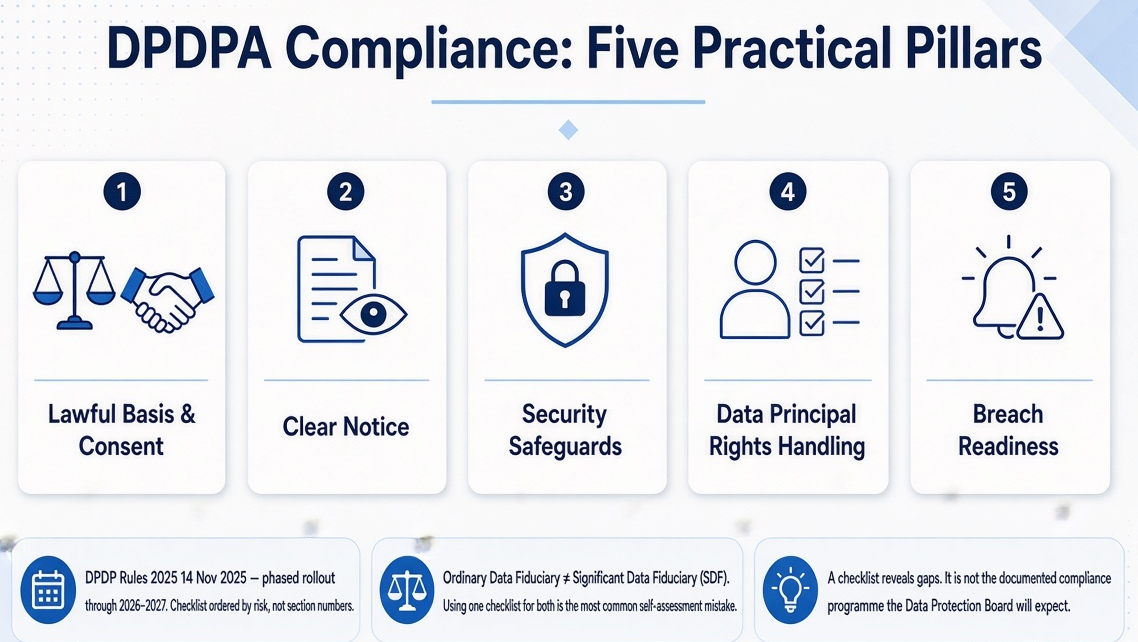
DPDPA Compliance Checklist: A Step-by-Step Self-Assessment Guide
Most "are we DPDPA compliant" conversations I sit in on start with someone printing out the Act and end with nobody sure what to do on Monday morning. Here is the checklist I actually use.