Data Fiduciary vs. Data Processor Under DPDPA: Roles, Obligations and Contract Templates
A definitional guide to Data Fiduciary and Data Processor under DPDPA, who carries legal liability for each role, and the clauses a data processing agreement needs to allocate that risk properly.
Key Takeaways
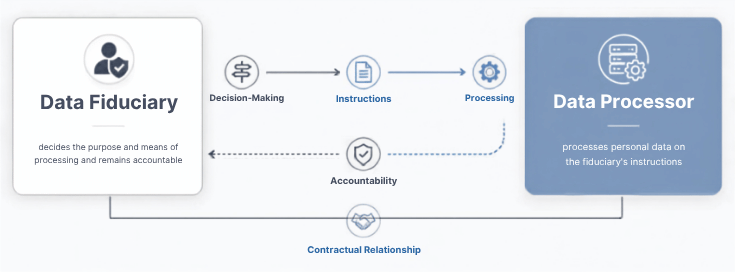
- A Data Fiduciary decides why and how personal data is processed. A Data Processor processes personal data only on the Fiduciary's instructions and has no independent decision-making role in the purpose of that processing.
- DPDPA places almost all direct statutory obligations, notice, consent, security safeguards, breach reporting to the Board, on the Data Fiduciary, not the Data Processor, which is a real difference from how GDPR treats processors.
- That does not make a processor risk-free. It makes the data processing agreement the main instrument that allocates security, breach-notification and liability obligations down the chain, so a weak contract is a weak control.
- The most common misclassification I see is a vendor that actually decides its own purposes, product analytics, marketing enrichment, model training, calling itself a processor because that is the cheaper compliance posture to claim.
What is the actual legal difference between a Data Fiduciary and a Data Processor?
A Data Fiduciary is whoever, alone or with others, determines the purpose and means of processing personal data, while a Data Processor is whoever processes personal data on behalf of a Data Fiduciary, under a contract, without deciding why that processing happens in the first place.
I have reviewed a lot of vendor contracts in my time, first as an internal auditor checking third-party risk, later as a virtual CFO negotiating them on a founder's behalf. The DPDPA definitions are actually fairly close to plain English once you strip the legal phrasing out. The Data Fiduciary is the decision-maker, the company that says "we are collecting this data because we want to do X with it." The Data Processor is the pair of hands, the payroll vendor, the cloud hosting provider, the customer support platform, that handles the data because the Fiduciary told it to, on the Fiduciary's terms, for the Fiduciary's purpose.
Where this gets interesting, and where I have seen genuine disputes, is when a vendor's product quietly starts making its own decisions about the data it touches. An analytics tool that was hired purely to process event data on your behalf, but then trains its own models on aggregated customer data across all its clients for its own product improvement, has stepped out of the processor role for at least that slice of processing. At that point it is arguably acting as a joint or independent Data Fiduciary for that specific purpose, whatever the contract calls it, because DPDPA cares about who actually determines the purpose, not what label sits at the top of the master services agreement.
Stay ahead of security and compliance risk
Get practical cybersecurity, audit readiness, and privacy management insights in your inbox.
Who carries legal liability if something goes wrong?
The Data Fiduciary carries almost all direct statutory liability under DPDPA, meaning it is the party the Data Protection Board can penalise for a breach, inadequate consent or a rights violation, even when a processor's failure caused the underlying incident.
This is the point that surprises people who have worked with GDPR, which imposes meaningful direct obligations on processors too. DPDPA is built differently. Section 8 loads the operational obligations, reasonable security safeguards, breach notification, grievance redressal, onto the Data Fiduciary. A Data Processor's obligations largely exist by contract, flowed down from the Fiduciary, rather than as a direct statutory duty enforceable by the Board against the processor itself.
So if your payroll vendor gets breached and your employees' salary data leaks, it is your company, the Fiduciary, that the Data Protection Board comes to first, not the vendor. That reality should change how you negotiate every vendor contract you sign from here. I think the biggest mistake founders make is treating "we outsourced it" as risk transfer. Under DPDPA it is closer to risk delegation with a very thin contractual net underneath it, and that net is only as strong as the clauses you actually put in the agreement.
What should a data processing agreement with a vendor actually cover?
A DPDPA-ready data processing agreement needs, at minimum, a defined and limited processing purpose, mandatory security safeguards, a short internal breach-notification window back to the Fiduciary, audit rights, sub-processor controls, and a clear data return or deletion obligation on termination.
Here is the checklist I run through with clients when a vendor contract crosses my desk, since I would rather have this conversation before signature than after an incident.
Core clauses: • processing scope limited explicitly to the Fiduciary's stated purpose, with no silent secondary use • confidentiality obligations extending to all vendor personnel and sub-processors • security safeguards matched to the sensitivity of the data, encryption, access controls, logging • a breach-notification clock that runs to the Fiduciary in hours, not days, since the Fiduciary's own 72-hour clock to the Data Protection Board starts running regardless of when the vendor tells them • audit and inspection rights, even if exercised rarely, because the right to ask matters more than how often you use it • explicit sub-processor consent and flow-down of the same obligations to any fourth party the vendor brings in • data return or certified deletion within a defined window on contract termination, with no "we'll get to it" language.
I would also flag one clause people forget: an indemnity that reflects the reality above, that regulatory penalties will likely land on the Fiduciary first. A processor that will not accept meaningful liability exposure for its own security failures is, in effect, asking you to insure their risk for free.
How do you avoid misclassifying a vendor's role in the first place?
Ask who decides the purpose of each specific processing activity, not who owns the overall relationship, because the same vendor can be a straightforward processor for one workflow and a joint Data Fiduciary for another within the same contract.
I think the practical fix here is boring but effective, and boring is usually what saves you in this line of work. Map processing activity by activity, not vendor by vendor. Ask, for each thing a vendor does with your data, who decided that this particular use should happen and why. If the answer is "we told them to," it is processing on your behalf. If the answer drifts toward "their product does this by default for all customers," you may be looking at a purpose the vendor itself determined, which changes the classification and the liability conversation for that slice of data, however the master agreement is titled.
Frequently Asked Questions
Can the same company be both a Data Fiduciary and a Data Processor?
Yes, and this is common. A HR software vendor might be a Data Processor for the payroll data it processes on a client's behalf, while acting as a Data Fiduciary for its own employees' data and for any product usage analytics it decides to generate independently.
Do Data Processors have any direct obligations under DPDPA at all?
DPDPA's direct statutory obligations sit mainly with the Data Fiduciary, so a processor's duties come primarily from contract. That said, a processor still needs to comply with the security and confidentiality terms it agreed to, and a Fiduciary should not assume a processor is off the hook entirely simply because the Act names the Fiduciary first.
What happens if our data processing agreements were written before DPDP Rules 2025 came out?
I would treat that as a priority remediation item, not an emergency, given the phased rollout. Audit existing vendor contracts against the checklist above, prioritise vendors touching sensitive or high-volume personal data first, and renegotiate at renewal if a full amendment is not practical immediately.
Sources & References

Written by
Ankit Manglik
Co-Founder, Cybersecurity and Compliance
Ankit brings 25+ years of experience across GCCs, finance, cybersecurity, internal audit, privacy programs, and enterprise compliance.
View author profileRelated Services
Need your vendor contracts reviewed for DPDPA risk?
Interakson helps founders and finance leaders rewrite data processing agreements so liability sits where it actually belongs, before a regulator or an auditor finds the gap.
Talk to our GRC teamShare this article
Stay ahead of security and compliance risk
Get practical cybersecurity, audit readiness, and privacy management insights in your inbox.
You may also like
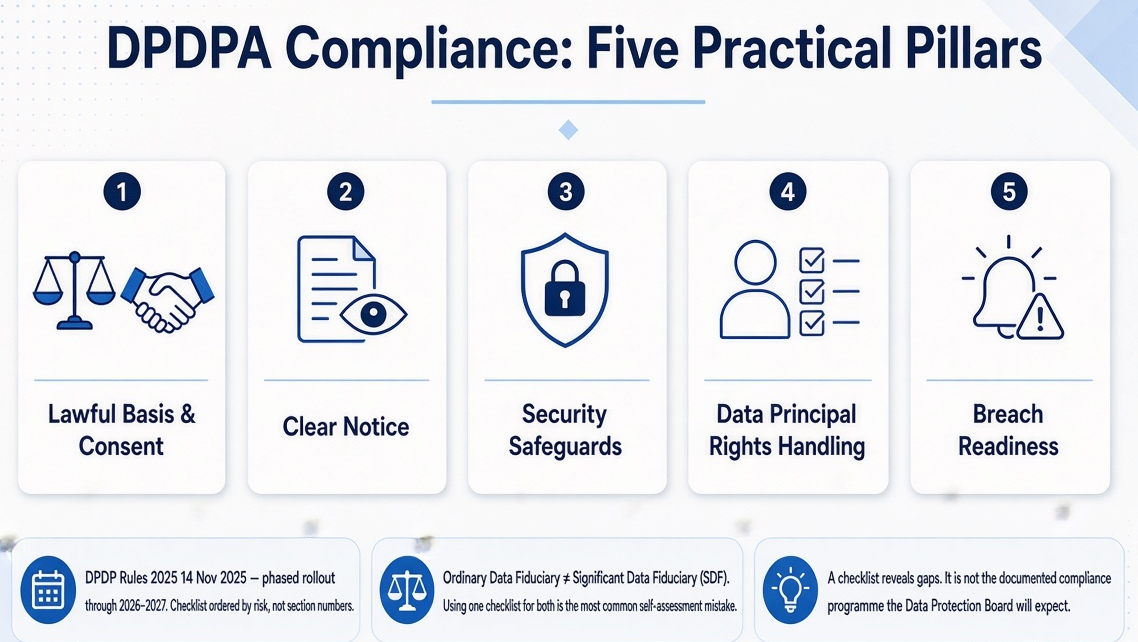
DPDPA Compliance Checklist: A Step-by-Step Self-Assessment Guide
Most "are we DPDPA compliant" conversations I sit in on start with someone printing out the Act and end with nobody sure what to do on Monday morning. Here is the checklist I actually use.