7 Types of DPDPA Consent Management Platforms, and How to Choose One
A buyer's guide to consent management platforms (CMPs) for DPDPA compliance, covering the difference between a CMP and a statutory Consent Manager, an evaluation framework, and a shortlist grouped by buyer profile rather than unverified pricing claims.

Key Takeaways
- A registered "Consent Manager" under DPDP Rule 4 is a specific statutory role, requiring incorporation in India and a minimum net worth of roughly two crore rupees, and almost no ordinary business needs to register as one. What most companies actually need is a Consent Management Platform, software they use internally, which does not require registration with the Data Protection Board.
- Evaluate a CMP on four things: whether consent is itemised and specific rather than bundled, whether withdrawal actually propagates to every downstream system, whether the audit trail is immutable, and whether the notice language supports the languages your users actually use.
- I would treat every "top CMP" listicle, including this one, with some scepticism. This is a fast-moving, fairly new vendor category in India, and I would rather send you in with good evaluation questions than a stale ranked list with pricing that may already be wrong by the time you read it.
- The right platform depends heavily on your buyer profile. A multinational already running a global privacy suite has different needs from an India-first startup that just needs DPDPA-native consent flows out of the box.
Is a Consent Management Platform the same thing as a DPDPA Consent Manager?
No. A Consent Manager is a registered statutory entity under DPDP Rule 4 that operates interoperable consent infrastructure across unrelated Data Fiduciaries, while a Consent Management Platform is ordinary software your own company licenses to run its own consent flows, and it requires no registration.
This mix-up trips up a lot of procurement conversations, so it is worth sorting out before you shop. Rule 4 sets a real bar for anyone wanting to register as a Consent Manager with the Data Protection Board: incorporation in India, a minimum net worth of around two crore rupees demonstrated through audited financials, proven technical capability to run the full consent lifecycle at scale, and a fit-and-proper standing assessment of the entity and its promoters. That role is meant for businesses building shared, interoperable consent infrastructure across multiple companies, not for a single company managing consent for its own product.
If you run a SaaS product, an e-commerce site or a mobile app and you are shopping for "a consent manager," what you almost certainly need is a Consent Management Platform, a vendor tool that helps you capture, store and honour consent for your own users. I would gently correct anyone on your team using the two terms interchangeably in a Board or investor conversation, because it changes what compliance obligation you are actually solving for.
Stay ahead of security and compliance risk
Get practical cybersecurity, audit readiness, and privacy management insights in your inbox.
What should a DPDPA-ready CMP actually do?
A DPDPA-ready CMP needs itemised, purpose-specific consent capture, a withdrawal mechanism as easy to use as the original opt-in, an immutable audit trail, and multilingual notice support, at minimum.
Here is the checklist I use when a client asks me to sit in on a CMP vendor demo. • Itemised consent per purpose, not a single bundled toggle for "all processing" • withdrawal that is genuinely one step, not buried three menus deep • an audit trail that can prove what a specific user consented to and when, in a format the Data Protection Board could actually review • multilingual notice support if your user base interacts with you in more than one language • integration hooks into your actual systems, CRM, marketing tools, product database, so a withdrawal in the CMP genuinely stops downstream processing rather than just updating a dashboard nobody else reads.
That last point is where I have seen the most CMP implementations quietly fail. The platform looks compliant in a demo because the consent banner is polished, but nobody connected the withdrawal webhook to the marketing automation tool, so an opted-out user keeps receiving targeted campaigns for months. A CMP is only as good as the integrations behind it, and that is a technical implementation question, not a vendor selection question.
Which category of CMP fits which kind of buyer?
Global privacy suites like OneTrust, TrustArc and Securiti suit multinationals already juggling GDPR and other regimes alongside DPDPA, cookie-focused platforms like Cookiebot and Usercentrics suit simpler website consent needs, and a growing set of India-first, DPDPA-native vendors suit startups that want the Act's specific requirements built in from day one rather than adapted from a GDPR template.
Global privacy suites, OneTrust, TrustArc and Securiti are the names I hear most often in enterprise procurement conversations, tend to bring mature consent tooling plus data discovery and vendor risk features in one platform. Their honest limitation for an India-only business is that most were built GDPR-first, so DPDPA-specific nuances, the children's consent rules, the Board reporting format, may need configuration rather than arriving out of the box.
Cookie and website-consent specialists, Cookiebot and Usercentrics being the two I see most, are strong if your primary need is website and app tracking consent rather than a full enterprise consent governance programme. They are usually faster and cheaper to deploy, and a reasonable starting point for an SME that mainly needs a compliant cookie banner and basic preference centre.
India-first, DPDPA-native platforms are the newest and fastest-growing category, built specifically around the Act's language and the Board's expected reporting format, and it includes both new entrants and India-market offshoots of established players. I would treat any specific vendor name and pricing you read in a comparison blog, including this kind of article, as a starting point for a demo request rather than a final answer, because this category is changing month to month right now and self-published pricing is often aspirational at best.
What should you ask a CMP vendor before signing a contract?
Ask how withdrawal actually propagates to downstream systems, whether the audit log is tamper-evident, how the platform handles verifiable parental consent if you serve users under 18, and what happens to your consent records if you ever switch vendors.
That last question matters more than it sounds. Consent records are evidence you may need to produce years after the fact, if the Data Protection Board ever asks about a specific complaint. I would want a contractual commitment on data portability and export format before signing, not an assumption that the vendor will sort it out later if you ever leave.
Frequently Asked Questions
Do we need to register as a Consent Manager to use a consent management platform?
No. Registering as a Consent Manager under Rule 4 is only necessary if you are building interoperable consent infrastructure that other, unrelated Data Fiduciaries connect to. Buying and configuring a CMP for your own product does not require any registration with the Data Protection Board.
Can we just build our own consent banner instead of buying a CMP?
You can, and some early-stage teams do, but the hard part is rarely the banner itself, it is the audit trail, the withdrawal propagation across every downstream system, and keeping the notice language current as your processing purposes change. I would only recommend building in-house if you have engineering capacity dedicated to maintaining it long term.
How much should we expect to pay for a DPDPA-ready CMP?
Pricing varies widely by vendor tier and scale, and I would not trust a fixed number from any single blog post, including this one. Get live quotes from at least three vendors across the categories above and compare them against your actual user volume and integration complexity.
Sources & References

Written by
Ankit Manglik
Co-Founder, Cybersecurity and Compliance
Ankit brings 25+ years of experience across GCCs, finance, cybersecurity, internal audit, privacy programs, and enterprise compliance.
View author profileRelated Services
Need help evaluating consent platforms for your product?
Interakson runs vendor bake-offs and implementation reviews so your CMP choice actually holds up under a Data Protection Board inquiry, not just in a sales demo.
Talk to our GRC teamShare this article
Stay ahead of security and compliance risk
Get practical cybersecurity, audit readiness, and privacy management insights in your inbox.
You may also like
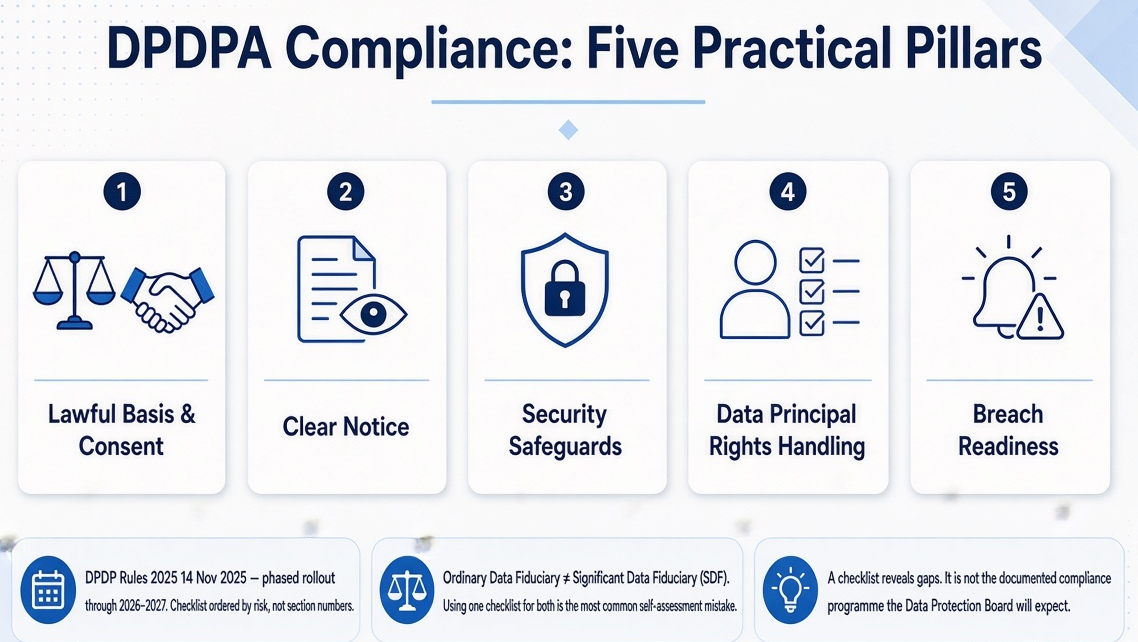
DPDPA Compliance Checklist: A Step-by-Step Self-Assessment Guide
Most "are we DPDPA compliant" conversations I sit in on start with someone printing out the Act and end with nobody sure what to do on Monday morning. Here is the checklist I actually use.